
Keep More of Every Cut, Color & Style
Booth rental vs W-2, chair lease deductions, product inventory: salon taxes are uniquely complex. We turn that complexity into a clear, quantified tax strategy.
A guide by Taxstra Tax & Accounting · CPA-led tax strategy for business owners
The Salon Owner Tax Trap
Why salon & barbershop owners face unique tax challenges
Salon and barbershop owners operate in one of the most tax-complex service industries. Unlike a traditional storefront or professional practice, you navigate an intricate landscape of worker classification rules, cash flow realities, and industry-specific expenses. Many salon owners we meet have been leaving $10,000+ annually on the table, not by choice, but by not understanding the unique rules that apply to their industry.
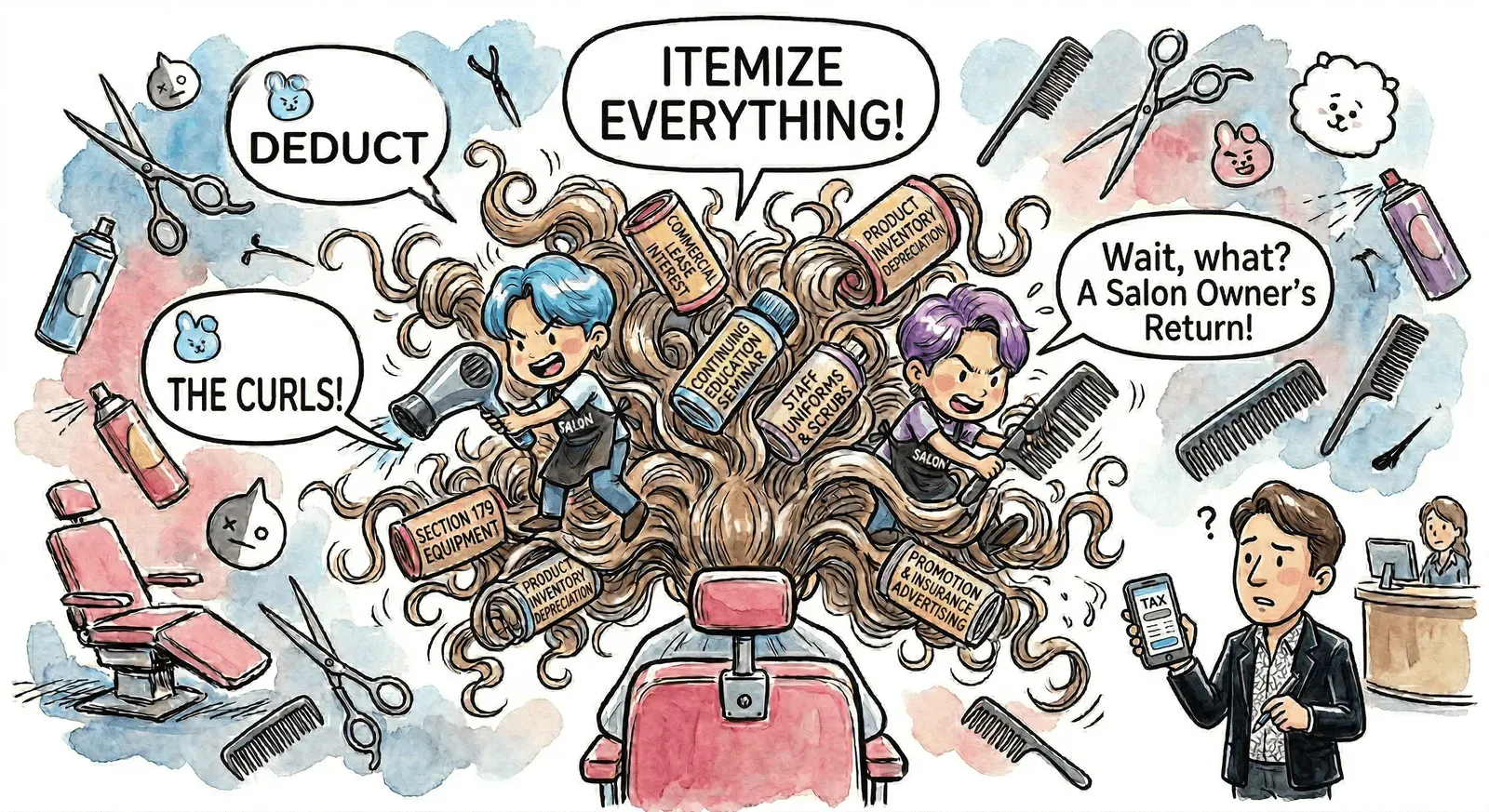
Booth Renter vs Employee Misclassification
The IRS considers salon worker classification a high-risk area. The distinction between an independent booth renter and a W-2 employee determines tax obligations, benefits, liability, and audit exposure. Many salon owners genuinely try to get this right but misunderstand the IRS's common-law classification test. The consequences? Reclassification audits that can result in penalties of $50+ per worker per quarter, plus back payroll taxes, interest, and potential criminal referrals.
Cash-Heavy Business Creates Recordkeeping Challenges
Salons operate with significant cash revenue. Walk-in clients, same-day payments, and daily cash handling make it easy for expenses to blur with owner draws. Without rigorous daily tracking, you risk underclaiming legitimate deductions or, worse, creating audit exposure if the IRS questions your cash deposits. Many salon owners reconcile their bank accounts only at year-end, making it nearly impossible to support their tax return.
Product Inventory vs Supplies Distinction
The IRS treats color, shampoo, developer, and styling products differently depending on whether they're cost of goods sold (COGS) or operating expenses. COGS affects your gross profit and self-employment tax calculations. Many salon owners either expensed all product costs (missing deductions) or capitalized them incorrectly (overstatement). Proper classification can shift your net profit by thousands of dollars.
Tip Reporting & Accuracy
If you have W-2 employees, tip reporting is required and audited frequently. If you're a booth renter, tips are entirely your income and must be reported on your Schedule C. The IRS cross-references tip income against card processor data (Square, Toast, Clover) and cash tracking. Underreporting tips can trigger automatic audits, even if your actual income is correct.
IRS Crackdowns on Salon Worker Misclassification
The Department of Labor and IRS have increased audit frequency in the salon and beauty industry. If you have booth renters but provide any control over hours, pricing, or product use, you're at risk. A single misclassified worker can trigger a full salon audit, affecting your entire staff and 3+ years of returns. Proper classification from the start is non-negotiable.
Booth Renter vs Employee: The #1 Salon Tax Decision
How you structure your workforce determines your tax liability
This is the single most important tax decision you'll make as a salon owner. The difference between 1099 and W-2 status affects your tax liability, risk profile, and ability to plan. The IRS doesn't ask what you call workers; it weighs behavioral control, financial control, and the relationship of the parties to determine "economic reality" and true worker independence.
Booth Renter vs W-2 Employee: The Complete Comparison
| Factor | Booth Renter (1099) | W-2 Employee |
|---|---|---|
| Worker Control | You set your own hours, pricing, products | Salon sets hours, pricing, uses salon products |
| Tax Form | 1099-NEC (you pay self-employment tax) | W-2 (salon withholds & pays half of SE tax) |
| Deductions | Claim all business expenses, many home office items | Limited to unreimbursed employee expenses (rare) |
| Benefits | No benefits from salon; you obtain your own | Eligible for salon benefits, unemployment insurance |
| Liability | You responsible for own liability insurance | Salon may carry coverage; verify in agreement |
| Self-Employment Tax | You pay full 15.3% SE tax on net profit | Only 7.65% withheld by salon (no additional SE tax) |
Misclassification Penalties Are Severe
Misclassifying even one employee as a booth renter triggers IRS penalties of $50+ per worker per violation, back payroll taxes, interest, and potential fraud penalties. If you have 3 misclassified employees over 3 years, your exposure is easily $15,000+. The worst part: the IRS often discovers misclassification during routine audits and the penalties are non-negotiable.
How to Properly Structure Booth Rental Agreements
A true booth rental agreement must demonstrate independence across multiple factors:
- •Pricing: Booth renters set their own service prices and can adjust independently
- •Products: Booth renters use and source their own products (or have freedom to choose from salon-provided options)
- •Hours: Booth renters choose their own hours within salon operating times
- •No benefits: Salon provides no health insurance, retirement plans, or paid leave
- •Rent structure: Clean, independent rent payment (not commission-based)
- •Documentation: Written agreement signed by both parties, independent contractor representation
Deductions That Keep Your Chair Profitable
Salon and barbershop-specific deductions you may be missing
Salon owners often underclaim deductions because they don't realize which expenses are deductible or how to classify them. Below are the most commonly missed deductions that apply to your business.
Chair & Station Rental or Lease Payments
Whether you rent a single chair as a booth renter or own a salon and lease space, chair/station rental is 100% deductible. This includes any rent paid to a salon owner for your booth. Keep receipts or cancelled checks proving monthly rent payments.
Professional Tools & Equipment
High-end shears, clippers, blow dryers, styling chairs, wash stations, and mirrors are deductible. Items under $2,500 can be expensed immediately under Section 179 expensing (or depreciated over time if you prefer). Many salon owners depreciate tools over 5 years when they could expense them immediately and claim the deduction today.
Products & Supplies (COGS vs Operating Expense)
This is where many salon owners make critical mistakes. Here's the distinction:
- •COGS (Cost of Goods Sold): Products purchased for resale (hair color, shampoo, conditioner, styling products clients buy) are inventory and cost of goods sold; they reduce gross profit
- •Operating Expense: Supplies used in delivering services (developer, bleach, cotton pads, towels, cleaning supplies) are operating expenses
Note: COGS classification affects self-employment tax calculations. If you sold $30,000 in product but classified it as expense instead of COGS, you overstated your net profit by $30,000 and paid an extra $4,240 in self-employment tax. This is one of the most expensive mistakes salon owners make.
Continuing Education & Professional Development
Advanced color certification, barbering courses, master classes, and beauty school continuing education are 100% deductible. This includes travel to attend courses, materials, and instructor fees. Many salon owners pay cash for education and never claim it because they don't realize it's deductible.
Licensing & State Board Fees
State cosmetology or barber board licenses, renewal fees, and endorsements are fully deductible. This is straightforward but often overlooked.
Uniforms, Aprons & Smocks
Professional attire required for work (smocks, salon-branded apparel, comfortable shoes for standing all day) is deductible, but only if it's not suitable for everyday wear. The IRS doesn't allow deductions for regular clothing that could be worn outside the salon.
Marketing & Client Acquisition
Instagram ads, Yelp premium listings, Google Local Services Ads, business cards, salon signage, and promotions are all fully deductible. Many salon owners pay for digital marketing and forget to track it for taxes.
Software & Booking Platforms
Subscriptions to Square, Vagaro, Booksy, Fresha, or any salon management software are deductible. Monthly payments, annual subscriptions, and integration fees all count.
Insurance (General Liability, Salon Liability, Workers Comp)
All business insurance premiums are deductible. If you have W-2 employees, workers' compensation insurance is required and deductible. General liability insurance protects you against client injury claims.
Entity Structure & Tax Savings
Schedule C vs LLC vs S-Corp: which is right for your salon?
Entity structure is one of the most misunderstood, and most valuable, tax planning decisions. Many salon owners operate as sole proprietors (Schedule C) without realizing they could save $10,000-$15,000 annually with a simple entity change. Here's how to evaluate your situation.
Solo Booth Renter or Single-Chair Owner: Schedule C vs S-Corp
Schedule C (Sole Proprietor): You report all income and expenses on Schedule C, and pay self-employment tax (15.3%) on 92.35% of net profit. This works fine if your net income is under $40,000-$50,000.
S-Corp Election (File Form 2553): You form an LLC and elect S-Corp taxation. You pay yourself a "reasonable salary" (W-2 income subject to payroll tax) and take the rest as a dividend distribution (not subject to self-employment tax). Example: $80,000 net income as Schedule C costs $11,304 in SE tax. The same income as an S-Corp with a $50,000 salary costs $7,650 in payroll tax (employer + employee), saving you $3,654.
Threshold: S-Corp generally makes sense when your net profit exceeds $60,000-$70,000. Below that, the accounting and filing fees don't justify the tax savings.
Multi-Chair Salon Owner: LLC vs S-Corp
LLC (Default Taxation): An LLC files no separate tax return; you report business income on your personal Schedule C. You pay self-employment tax on all net profit. This is simple but expensive for multi-chair salons with $100,000+ in profit.
LLC Taxed as S-Corp: Your LLC elects to be taxed as an S-Corporation (Form 2553). The LLC files a Form 1120-S return; you pay yourself a W-2 salary and take distributions. For a multi-chair salon with $250,000 net income, a reasonable salary might be $140,000 (subject to payroll tax of ~$19,620), and you take $110,000 as a distribution (no self-employment tax). As a Schedule C, the same income would cost $35,355 in self-employment tax, saving you $15,735 annually.
Threshold: S-Corp election almost always makes sense for multi-chair salons earning $100,000+ in profit. The savings dwarf the accounting costs.
C-Corporation (Rare but Possible)
C-Corporations are taxed at a flat 21% corporate rate, and you also pay individual tax when you distribute profits (double taxation). This is almost never optimal for salon owners unless you're planning to reinvest significant profits for expansion, retain earnings for business growth, or have unusual circumstances. Discuss with a CPA before considering a C-Corp.
S-Corp Savings for Salon Owners Earning $80K+
A salon owner earning $100,000 in net profit can save an estimated $5,000-$7,000 annually by electing S-Corp status; one earning $200,000 can save an estimated $12,000-$15,000. These are recurring annual savings. You need to pay yourself a 'reasonable' salary (the IRS monitors this), but the remaining profit can be distributed without self-employment tax. This is one of the most proven tax strategies in existence.
Why Taxstra for Salon & Barbershop Owners
How we serve salon owners differently
Taxstra was built to serve business owners like you: people who've turned a passion into a profitable enterprise but need expert tax guidance. We don't just prepare returns; we implement tax strategies throughout the year to keep more money in your pocket.
We Understand the Booth Rental Model Inside and Out
We work with hundreds of booth renters and salon owners. We know the IRS's worker classification scrutiny in your industry. We'll structure your agreements correctly, document your independence, and ensure you're not exposed to audit risk. We also work with salon owners who hire booth renters; we help you classify correctly and stay compliant.
We Handle Tip Reporting and Worker Classification Correctly
Tip income is frequently audited in the salon industry. If you have W-2 employees, we ensure tips are reported accurately on W-2s and that your payroll taxes reflect the true income. If you're a booth renter, we make sure your tips are reported on your Schedule C without overstating or understating. This alone prevents costly audit adjustments.
Year-Round Tax Planning Around Seasonal Income
Salons experience seasonal fluctuations: high income in summer (weddings, graduations), slower in winter. We monitor your quarterly income and make real-time adjustments. If income is trending higher than expected, we discuss S-Corp strategy, retirement contributions, and estimated tax planning. We don't wait until April to tell you about tax planning opportunities.
We Help You Maximize Salon-Specific Deductions
From product COGS to booth rental deductions to continuing education credits, we know where salon owners leave money on the table. We conduct a full deduction review and identify missed opportunities, including deductions that were never claimed in prior years.
We Help You Get Tax Organized (Even If You Start Behind)
Many salon owners operate on cash and haven't tracked receipts carefully. We don't shame you; we help you get organized. We reconcile bank and credit card statements, help you reconstruct reasonable expense records, and set you up with systems that make next year automatic. From day one, we're your tax strategist, not just a preparer.
Resources for Salon Owners
Complete Salon Tax Deductions Guide
Educational guide covering all deductible expenses for salon owners
S-Corp Savings Calculator
See exactly how much you could save by electing S-Corp status
S-Corp Optimization Strategy
Deep dive into how S-Corp elections work for service businesses
Home Office Deduction Guide
If you run a salon from home or have a home office for administrative work
Frequently Asked Questions
Common questions from salon and barbershop owners
Ready to Save on Your Salon Taxes?
Book a free 30-minute consultation with our team. Tell us what you need, learn how Taxstra can help, and explore whether our services are a good fit. Tax advice, document reviews, and analysis require a paid engagement.
Related Taxstra resources
Continue with the services, planning tools, and explainers most relevant to this topic.
- restaurant tax deductions
- S Corp Tax Calculator
- Self Employment Tax Calculator
- Solo 401k Contribution Calculator
- Form W-9 Explained
- S Corp Reasonable Salary
- S Corp Vs C Corp
- Salt Tax Deduction
- Simplified Home Office Deduction
- Estimated Tax Payments
- Accounting Needs Assessment
- Augusta Rule Calculator
- Bookkeeping Cleanup Cost